

- Outdoor Clothing and Footwear

- All in the category Outdoor Clothing and Footwear
- Footwear

- Jackets

- Military Blouses

- Pants

- Functional clothing

- Sweatshirts

- Shirts

- Hawaiian & Lifestyle Shirts

- T-Shirts

- Shorts and Bermuda

- Overalls

- Caps and head coverings

- Gloves

- Socks

- Belts

- Suspenders

- Scarves, shawls, neckwear

- Raincoats, ponchos

- Women's clothing

- Children's clothing

- Clothing Care and Maintenance

- Patches & Insignia

- Vests

- Camping & Hiking

- All in the category Camping & Hiking
- Backpacks

- Bags, Cases & Waist Packs

- Sleeping in nature

- Cookers, grills

- Lighting a fire

- Outdoor Dishes and Tableware

- Dining in nature (Food for the journey)

- Survival kit

- Compasses

- Climbing equipment

- Flashlights

- Camping furniture

- Eye-glasses

- Telescopes

- Hydration

- Water purification

- Small Equipment and Essentials for Survival

- Electronics and accessories for mobile phones

- Watches

- Cases

- Paracords

- Wallets

- Towels

- Solar showers

- Waterproof notebooks

- Mosquito and Insect Protection

- Foot, hand, and body warmers

- Repair Kits and Adhesive Tapes

- Boating equipment

- Health, protection

- Tactical Gear

- All in the category Tactical Gear
- Plate Carriers and Tactical Accessories

- Load-bearing harnesses

- Tactical vests

- Tactical cases and pockets

- Ballistic protection

- Hearing protection

- Protection

- Tactical and military backpacks

- Tactical and combat belts

- Tactical Eyewear

- Flashlights for soldiers and police

- Helmets, coverage

- Camouflage

- Gas masks and protective equipment

- Medical equipment

- Boxes, cases

- Battering rams, crowbars

- Gear for dogs

- Shooting Gear

- All in the category Shooting Gear
- Shooting Glasses

- Weapon bags

- Shooting gloves

- Gun Cases

- Weapon Slings

- Optical sights

- Rangefinders

- Gun flashlights and lasers

- Cleaning, maintenance

- Gun waist bags

- Shooting bags

- Shooting mats

- Boxes and cases for ammunition

- Training equipment for shooting

- Bullet traps

- Speed loaders

- Knives and Tools

- Self-defence

- Firearms and Ammunition

- Other

- By interest


Firearm Suppressors: A Practical Guide to Selection and Use
Few firearm accessories generate as much discussion as suppressors. Often misunderstood and frequently shaped by their portrayal in movies and video games, they have become an increasingly common sight on the firearms of sport shooters, hunters, and professional users. Their role extends well beyond reducing sound signature. Depending on the application, a suppressor can improve shooting comfort, enhance hearing protection, and reduce several of the undesirable effects associated with firing a weapon.
Whether you are considering your first suppressor or simply want to better understand how these devices work, it pays to know what they can and cannot do. In this guide, we take a closer look at suppressor design, mounting systems, practical advantages and drawbacks, and the legal requirements that apply to their ownership in the Czech Republic.
Why Do Shooters Use Suppressors?
Although suppressors are most commonly associated with reducing sound signature, that is only one of several reasons they have become widely used on sporting, hunting, and service firearms. The specific benefits vary depending on the firearm and its intended role, but the most common reasons include:
- Hearing protection during training and live-fire use.
- Improved shooting comfort, particularly during extended range sessions.
- Reduced noise exposure for both the shooter and those nearby.
- Mitigation of certain firing effects, such as muzzle flash and blast overpressure.
- Mission-specific or application-specific requirements, whether for hunters, competitive shooters, or professional users seeking additional performance benefits.
The practical advantages, drawbacks, and technical considerations of suppressor use are covered in greater detail throughout the rest of this article.

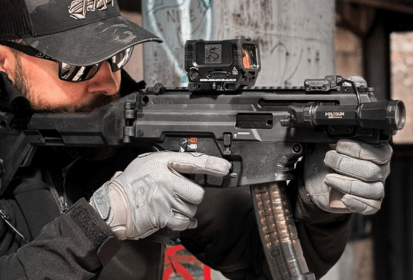
Sound suppressors are a common addition to modern sporting, duty, and hunting firearms. In addition to reducing noise, they can also influence how the firearm behaves during shooting.
Are Suppressors Legal in the Czech Republic?
Yes, suppressors are legal in the Czech Republic. Under Czech firearms legislation, however, they are classified as regulated firearm components and fall under Category R4.
A valid firearms licence is required to purchase a suppressor, and its acquisition must be reported within 10 days. Each suppressor is marked with a unique serial number and proof-house markings issued by the Czech Proof House for Firearms and Ammunition (ÚZZS).
How Does a Suppressor Work?
A suppressor is designed to reduce the sound generated when a firearm is discharged. The sound of a gunshot consists of two primary components: the sonic crack produced when a projectile exceeds the speed of sound, and the rapid expansion of high-pressure gases that propel the bullet down the barrel.
Once these gases exit the muzzle, they expand violently into the surrounding air. The purpose of a suppressor is to control and slow this expansion. As the gases pass through the suppressor, their flow is redirected, slowed, and partially cooled. This significantly reduces the overall sound signature of the shot.
A suppressor generally has little effect on bullet velocity, although some designs may produce a slight increase. It cannot eliminate the sonic crack of a supersonic projectile, but it can substantially reduce the noise generated by escaping propellant gases. Complete elimination of gunshot noise is impossible; suppression only reduces it to a lower level.
For perspective, a .223 Remington cartridge typically produces a sound level of approximately 150–160 dB. A suppressor may reduce this by as much as 30 dB. In practical terms, this can significantly reduce the risk of immediate hearing damage, which may occur at sound levels of roughly 120–140 dB.
Even when using a suppressor, hearing protection should always be worn. Repeated or prolonged exposure to noise levels above 80–85 dB can still cause permanent hearing damage. Tinnitus is an unwelcome companion that is best avoided.


What Types of Suppressors Are Available?
Suppressors are available in a wide range of configurations. They are most commonly classified by firearm type, calibre, or intended application:
- By firearm type – for example, pistol, rifle, or rimfire suppressors. This classification primarily reflects different design and performance requirements.
- By calibre – suppressors are typically rated for a maximum projectile diameter or cartridge size. While a suppressor can generally be used with smaller calibres, suppression performance may not be as effective.
- By intended use – such as hunting, sporting applications, or fully automatic fire. This largely determines the required durability, heat resistance, and overall weight of the suppressor.
How Is a Suppressor Attached to a Firearm?
With the exception of a small number of permanently integrated designs, most suppressors can be removed from the firearm for maintenance and cleaning. Understanding the most common mounting systems is therefore well worth the effort.
Direct Thread Mount
The most common method of attaching a suppressor is a direct-thread mount on the barrel, either right-hand (RH) or left-hand (LH). This system is widely used on pistol, rimfire, and hunting suppressors.
Its main drawback is slower installation and a tendency to loosen during firing. This is not a design flaw but rather a characteristic of the system. Barrel vibrations generated during firing can gradually work the threaded connection loose over time.
Tri-Lug Mount
Another popular solution is the Tri-Lug mounting system and its various derivatives. It is essentially a bayonet-style interface featuring three lugs positioned around the circumference of the barrel at 120-degree intervals near the muzzle.
Once the barrel's Tri-Lug interface is inserted into the corresponding suppressor, the suppressor is secured by pushing and rotating it into position. In practical terms, this is one of the fastest suppressor mounting systems available. Installation and removal take only seconds.
The downside of some lower-cost systems is looser manufacturing tolerances, which may have a negative impact on accuracy.
Quick-Detach (QD) Mount
A Quick-Detach (QD) system allows rapid installation and removal of the suppressor. The suppressor interfaces with a dedicated muzzle device, such as a flash hider, and locks into place using a retaining mechanism. The suppressor is then secured with a short rotational movement.
Most systems also incorporate a locking feature designed to prevent loosening under vibration. The trade-off is greater sensitivity to manufacturing tolerances and proper installation of the muzzle device. Precise alignment is critical. Examples include the B&T Rotex V and Ase Utra QM2 suppressor systems.
QD Mount with Alignment Interface
A typical example of this design is Ase Utra's BoreLock system. In practice, the firearm's original muzzle device is replaced with a BoreLock-compatible muzzle brake or flash hider.
The system uses a threaded attachment interface, a locking collar that prevents loosening, and, most importantly, a tapered alignment surface that centres the suppressor precisely on the bore axis.
Proper suppressor-to-bore alignment is critical for both accuracy and suppressor longevity. If the suppressor is not perfectly aligned, the projectile may contact internal components during its passage through the suppressor. This can lead to degraded accuracy and, in severe cases, damage to the suppressor itself.

Sound suppressors vary in design, intended use, and mounting systems. When choosing one, it is important to consider the firearm type, caliber, and intended application.
What Are the Advantages and Drawbacks of Using a Suppressor?
Using a suppressor offers a number of benefits, but it also comes with certain trade-offs that should be considered before making a purchase. The extent of these advantages and drawbacks depends on the firearm platform, suppressor design, and intended application.
Advantages
The benefits of a suppressor extend well beyond reducing sound signature. Depending on the firearm and mounting system, a suppressor can positively influence several aspects of shooting performance.
✅ Hearing Protection and Improved Shooting Comfort
The primary purpose of a suppressor is to reduce the noise generated when a firearm is discharged. While it does not eliminate sound completely and should never replace proper hearing protection, it can significantly reduce overall noise levels. This benefits not only the shooter but also those nearby.
Reduced noise and lower blast overpressure also contribute to a more comfortable shooting experience. This is particularly noticeable during extended training sessions, on indoor ranges, or when communicating with other shooters and instructors.
✅ Improved Accuracy and Consistency in Certain Systems
By reducing the turbulent release of gases at the muzzle, a suppressor can have a positive effect on firearm accuracy. This reduces the influence of disruptive gas flow on the projectile as it exits the barrel.
✅ Improved Firearm Handling
Many shooters describe a suppressed firearm as feeling smoother and more controllable. The additional weight at the muzzle can also help reduce muzzle rise during firing.
✅ Reduced Visual Signature
One reason suppressors are commonly used on military firearms is their ability to reduce muzzle flash, particularly in low-light conditions. This makes it more difficult for an observer to identify the shooter's position.
Drawbacks
Suppressor use also introduces several challenges and additional requirements. Their significance varies depending on the firearm, suppressor design, and intended application, but they should be considered as part of the selection process.
❌ Cost
For high-quality rifle suppressors offering excellent sound reduction and durability, prices around CZK 20,000 are far from unusual. Achieving long service life, resistance to extreme heat, and minimal impact on accuracy requires premium materials, advanced engineering, and extensive testing.
The same applies to pistol suppressors, where prices around CZK 15,000 are also common. Pistols with a locked-breech, tilting-barrel design require a suppressor equipped with a so-called booster assembly (Nielsen device), which temporarily decouples suppressor weight from the barrel. This is essential for reliable unlocking, extraction, and ejection during the operating cycle.
❌ Suppressor Fouling
Firing a suppressor results in significant fouling from combustion by-products. Carbon deposits and vaporised lead from the projectile gradually accumulate inside the suppressor, forming a hard layer that grows with continued use.
Compared to the rest of the firearm, fouling inside the suppressor is often considerably more severe. Regular maintenance and cleaning are therefore essential. Manufacturer-recommended cleaning intervals should be followed, especially since some suppressors cannot be disassembled for internal mechanical cleaning and offer only limited options for chemical maintenance.
Pistol suppressors present a particular challenge. Excessive fouling can interfere with the operation of the booster assembly, leading to increased malfunctions. In practice, this can begin to occur after as few as 200–220 rounds without cleaning.
❌ Point-of-Impact Shift
It is important to verify how installing a suppressor affects both accuracy and point of impact. It is equally important to confirm whether removing and reinstalling the suppressor produces consistent results.
❌ Increased Firearm Fouling
Because a suppressor restricts the forward flow of gases at the muzzle, a greater volume of gas is redirected back through the chamber and operating system. This results in increased fouling throughout the firearm.
❌ Increased Wear
Additional fouling increases friction between moving components, accelerating wear. In semi-automatic firearms equipped with either a piston-driven or direct-impingement (DI) operating system, suppressor use can also increase system pressure and cycle speed.
This is often visible in the ejection pattern of spent cases. As cycle speed increases, ejection tends to move further forward.
Higher operating speeds and increased friction naturally accelerate wear. This also affects the barrel, whose service life and accuracy may be reduced due to increased fouling in the bore and higher friction levels.
❌ Heat
Suppressors become extremely hot during use. After only a few magazines, temperatures can be high enough to damage anything they come into contact with. This should always be taken into account during handling and transport.
❌ Ammunition Compatibility
Because suppressors influence the operating cycle of semi-automatic firearms—particularly pistols—it is possible that lighter-loaded ammunition may not generate enough energy to cycle the action reliably.
In such cases, it may be necessary to switch to ammunition loaded with heavier bullets. When a suppressor is combined with a heavier slide-mounted optic, such as the Aimpoint Acro, projectiles weighing 140 grains or more may be required to ensure reliable function.
Is a Suppressor Worth It?
Using a suppressor comes with its own set of considerations, maintenance requirements, and trade-offs. It demands additional care, regular cleaning, and, in some cases, adjustments to equipment or ammunition selection.
At the same time, suppressors can provide substantial benefits, including improved shooting comfort, enhanced hearing protection, and several practical performance advantages. It is no surprise that they have become increasingly popular among professional users, competitive shooters, and hunters alike.
A suppressor is not a necessary accessory for every firearm or every shooter. However, if you understand its capabilities and limitations—and are willing to adapt your maintenance routine accordingly—it can be a highly valuable addition to your equipment.


Readers are further interested