

- Outdoor Clothing and Footwear

- All in the category Outdoor Clothing and Footwear
- Footwear

- Jackets

- Military Blouses

- Pants

- Functional clothing

- Sweatshirts

- Shirts

- Hawaiian & Lifestyle Shirts

- T-Shirts

- Shorts and Bermuda

- Overalls

- Caps and head coverings

- Gloves

- Socks

- Belts

- Suspenders

- Scarves, shawls, neckwear

- Raincoats, ponchos

- Women's clothing

- Children's clothing

- Clothing Care and Maintenance

- Patches & Insignia

- Vests

- Camping and hiking

- All in the category Camping and hiking
- Backpacks

- Bags, satchels, suitcases, waist bags

- Sleeping in nature

- Cookers, grills

- Lighting a fire

- Outdoor Dishes and Tableware

- Dining in nature (Food for the journey)

- Survival kit

- Compasses

- Climbing equipment

- Flashlights

- Camping furniture

- Eye-glasses

- Telescopes

- Hydration

- Water purification

- Small Equipment and Essentials for Survival

- Electronics and accessories for mobile phones

- Watches

- Cases

- Paracords

- Wallets

- Towels

- Solar showers

- Waterproof notebooks

- Mosquito and insect protection

- Foot, hand, and body warmers

- Repair Kits and Adhesive Tapes

- Boating equipment

- Health, protection

- Tactical Gear

- All in the category Tactical Gear
- Plate Carriers and Tactical Accessories

- Load-bearing harnesses

- Tactical vests

- Tactical cases and pockets

- Ballistic protection

- Hearing protection

- Protection

- Tactical and military backpacks

- Tactical and combat belts

- Tactical Eyewear

- Flashlights for soldiers and police

- Helmets, coverage

- Camouflage

- Gas masks and protective equipment

- Medical equipment

- Boxes, cases

- Battering rams, crowbars

- Gear for dogs

- Shooting Supplies

- All in the category Shooting Supplies
- Shooting Glasses

- Weapon bags

- Shooting gloves

- Weapon cases

- Weapon Slings

- Optical sights

- Rangefinders

- Gun flashlights and lasers

- Cleaning, maintenance

- Gun waist bags

- Shooting bags

- Shooting mats

- Boxes and cases for ammunition

- Training equipment for shooting

- Bullet traps

- Speed loaders

- Knives and Tools

- Self-defence

- Firearms and Ammunition

- Other

- By interest


Dry-Fire Training: How to Practice Pistol Skills Without Going to the Range
Dry-fire training lets shooters work on weapon handling and core pistol skills without a trip to the range or the cost of live ammunition. It cannot replace live fire, but it can make training far more efficient. The key is knowing what to practice, which training aids are useful, and how to keep every session safe.
Dry Fire as Part of Pistol Training
Anyone who trains more seriously than firing a box of ammunition once a month will eventually look for ways to practice more often without driving up costs. Dry fire is one of the most practical options, allowing the shooter to work with the pistol without firing a live round.
Used between range sessions, dry fire makes it possible to isolate individual skills and refine them without recoil, noise, or the other distractions of live fire. But effective dry-fire practice is more than simply pressing the trigger on an unloaded pistol. It requires a clear objective, correct technique, and strict safety discipline.

A stable grip begins while the pistol is still in the holster. Dry-fire practice allows the draw to be repeated without using live ammunition. Photo: Rigad
What You Can Train Dry — and What Requires Live Fire
Dry fire lets you break pistol shooting into separate skills and work on them individually: stance, draw, grip, aiming, trigger control, target transitions, reloads, and malfunction clearance.
This makes it easier to analyze each movement, correct mistakes, and build consistent technique before spending live ammunition at the range. Range time can then be used more efficiently.
Dry fire has clear limits. It cannot reproduce recoil, the cycling of the action, sight or red-dot recovery after the shot, or weapon control during rapid follow-up fire. Dry fire complements live fire; it does not replace it. Skills developed dry must ultimately be validated at the range.
Before You Start: Safe Handling Rules
The same firearm safety rules apply to dry fire as to any other weapon handling. Train in a closed area where uninvolved people cannot enter and where handling a firearm cannot be mistaken for a threat or illegal activity. Avoid public areas and places clearly visible from outside.
Before training, establish a safe direction. The aiming point must have a solid backstop capable of stopping a bullet. Do not consider only what is directly in front of the muzzle; also account for what lies beyond doors, furniture, interior walls, or other barriers that may not stop a projectile.
Before every dry-fire session:
- Remove all live ammunition from the training area. Check pockets, clothing, holsters, pouches, and other equipment. No live rounds or loaded magazines should remain nearby.
- Point the firearm in the established safe direction and keep your finger off the trigger.
- Remove the magazine and open the action. Lock the slide to the rear if convenient, but this is not essential for the inspection.
- Visually and physically check the chamber, action, and magazine well. Inspect every magazine used for training as well. Never assume anything is unloaded.
- Close the action, confirm the safe direction, and perform a deliberate trigger press to verify the firearm is clear. Touch the trigger only when the gun is pointed toward a safe backstop.
- If the drill requires cartridges or loaded magazines, use dummy rounds only. Inspect each one before use and keep all training ammunition clearly separated from live rounds.

Dry-fire training can cover the entire reload sequence, from removing the magazine to returning the pistol to the line of sight. If cartridges are required, dummy rounds must be used exclusively. Photo: Rigad
If you interrupt the session, leave the training area, or otherwise lose direct control of the firearm, repeat the entire safety procedure before continuing. The same applies if anyone else handled the firearm or prepared equipment during the break.
Ending a dry-fire session should also follow a clear procedure. First set the firearm aside, put away all dummy ammunition and other training aids, and only then bring live ammunition back into the area. Once the firearm has been loaded with live ammunition again, the dry-fire session is over. Do not perform any further “practice” trigger presses.
Effective Practice: From Correct Execution to Speed
Dry-fire training delivers the most value when it has a clear structure and a specific objective. Instead of mindlessly repeating an entire sequence, choose one skill, focus on performing it correctly, and work on eliminating errors.Individual actions should first be practiced separately, deliberately, and in detail. Only after they are performed consistently should they be combined into complete sequences.
A few basic principles are worth following:
- Set a specific objective. One session might focus on establishing the grip during the draw, achieving a smooth trigger press, or performing a magazine change. A clearly defined goal makes it easier to evaluate technique and track progress.
- Prioritize quality over repetition count. High volumes of fast repetitions are pointless if they also reinforce mistakes. Each repetition should be controlled and technically sound.
- Build from individual movements to complete sequences. Break complex actions down into smaller components first. Once each part can be performed correctly and consistently, begin linking them into one smooth movement.
- Add speed gradually. Movement should become faster without sacrificing accuracy, weapon control, or safe handling. The familiar phrase “Slow is smooth, smooth is fast” captures the principle well.
- Use feedback. Training in front of a mirror, working with a partner, recording yourself on a phone, or using an electronic training system can all help identify errors. A safe direction must always be maintained. A shot timer should only be introduced once the shooter can perform the movement correctly and consistently.
Any technique developed through dry fire should then be validated with live fire. Only actual shooting will show whether those learned movements still work under recoil, during the firearm’s operating cycle, and under time pressure. The results of live-fire practice can then help determine which skill should become the focus of the next dry-fire session.

Except during the trigger press, the trigger finger stays outside the trigger guard. The same safety rules apply to live fire and dry-fire practice. Photo: Rigad
Shooting Stance and Body Position
A stable shooting position starts with solid fundamentals. Begin by repeatedly establishing a natural, balanced stance, paying attention to foot placement, shoulders, and pelvis. Some shooters prefer a slightly staggered stance with the non-dominant foot forward; others are more comfortable squared to the target.
In dynamic shooting, stance depends on personal preference and on whether the shooter is starting from a static position or settling after movement. The goal is not one universally correct stance, but the ability to adopt a stable position automatically for the situation at hand.
Practice on different surfaces, in different footwear, and under varied conditions. Movement drills can also include accelerating from a static position and stabilizing after movement. These elements can be trained without a firearm, allowing footwork to be practiced safely outside the dry-fire area.
Dry fire cannot show how a stance performs under recoil, but it can develop weight distribution, torso position, and overall stability. These must then be confirmed during live fire.
Drawing and Establishing the Grip
Grip, together with trigger control, remains one of the most common problem areas for both new and experienced shooters. Uneven hand pressure or poor placement can disturb alignment during the trigger press, while a low grip reduces recoil control and slows recovery.
A good grip starts while the pistol is still in the holster. If hand placement changes from draw to draw, the shooter must correct it during presentation.
Grip establishment and the draw should therefore be practiced as a separate dry-fire skill. The objective is a stable, repeatable grip before the pistol clears the holster.
Aiming with Iron Sights and a Red Dot
With either iron sights or a red dot, the goal is to bring the pistol onto the line of sight quickly and consistently. A clean draw and presentation should place the sights or dot naturally in view without searching or major correction.
This is especially important when transitioning from irons to a red dot. Beginners often hunt for the dot inside the optic. The solution is not to move the head or pistol around, but to build a consistent draw, grip, and presentation.
Dry-fire aiming practice should bring the sights or dot onto the intended point and keep them within the target area through the trigger press. Unwanted movement can reveal faults in grip, body position, or trigger control.


Trigger Control
How to Practice the Trigger Press
Trigger control is a common weak point for new and intermediate shooters. Typical errors include disturbing the pistol during the trigger press or anticipating recoil and dipping the muzzle before the shot breaks.
Dry fire lets the shooter focus on a smooth, controlled trigger press without disturbing the grip or sight picture. The sights or red dot should remain in the target area before, during, and immediately after the break. Any movement as the trigger resistance is overcome is easy to identify and correct on the next repetition.
With most striker-fired pistols and many SA designs, the firing mechanism must be reset between repetitions by cycling the slide or cocking the hammer. The exact method depends on the firearm. Although this slows the drill, it also gives the shooter a chance to recheck grip, sight alignment, and trigger-finger placement.
Can Dry Fire Damage the Firearm?
There is no universal rule. Some pistols tolerate limited dry firing without a cartridge, while others require a dummy round or other protection for extended practice. Rimfire firearms deserve particular attention because, depending on the design, the firing pin may strike the edge of the chamber.
Always follow the manufacturer’s instructions. An occasional function check and thousands of dry-fire repetitions place very different loads on the mechanism. Without a cartridge, the firing pin, striker, or other parts may stop differently than they do against a primer, which can accelerate wear on some designs.
Certain hammer-fired firearms can also use a dedicated hammer stop or similar device. It should be purpose-built for that firearm, not improvised. If the manufacturer recommends a dummy round or other protection, use it throughout the session.

Dry-fire training can be performed with the same pistol and magazine setup used at the range. All live ammunition must be removed from the training area before the session begins. Photo: Rigad
Dummy Rounds and Training Aids
Dummy rounds, often called snap caps, replace live ammunition during training. Depending on the design, they can be used for handling, reload, and malfunction drills while also cushioning the firing pin or striker. Some use a spring-loaded primer insert, while others rely on polymer or similar impact-resistant material.
Dummy rounds also wear out. The primer area gradually deforms and may eventually lose its protective function. Before each session, check them for cracks, excessive deformation, or other damage. They must also remain clearly separated from live ammunition.
More detailed feedback can be provided by electronic training systems such as MantisX. A sensor mounted on the firearm or an adapter tracks movement before, during, and immediately after the trigger press. The mobile app then displays the movement pattern and highlights likely grip or trigger-control errors. On striker-fired and SA pistols, however, the system does not reset the action, so the shooter must do so manually before each repetition.
Another option is a complete inert training pistol that replicates the size, controls, and handling of a real firearm. The Mantis TitanX, for example, uses an auto-resetting trigger that activates a short laser pulse. Its integrated MantisX system also analyzes pistol movement and provides feedback through a mobile app.
Variants based on the Glock 17, Glock 19, and Glock 45 also allow draw practice and reloads with weighted training magazines. The main advantage is uninterrupted practice without repeatedly cycling the slide; the drawback is the higher purchase price.
A simple trigger-control drill can also use an empty cartridge case or coin placed on the slide or sights, depending on the pistol. The goal is to press the trigger without knocking it off. It is cheap and useful for detecting obvious movement, although it provides far less detail than an electronic training system.
TIP: Training with an AR-15 as well?
Mantis Blackbeard allows dry-fire practice with your own rifle, automatically resets the trigger, and provides instant laser feedback.
View the Mantis Blackbeard for AR-15

Target Transitions
A target transition is the movement of the gun from one target or aiming point to another. It is an important skill when engaging multiple targets, particularly in competition, defensive, and tactical shooting.
The goal is to use just enough force to make the transition fast while allowing the pistol to settle smoothly in the new target area without unnecessary correction. The eyes usually move to the next target first and the gun follows. If the movement is too aggressive, the pistol may overshoot, forcing the shooter to correct back and settle again.
During dry fire, you can monitor not only speed but also the path of the gun and the moment when the sights or red dot settle on the intended point. Speed should only be increased if the movement can still be stopped consistently in the target area.
Reloading
Smooth reloads are essential in dynamic shooting. They allow the shooter to restore the firearm to a ready condition and continue firing. The main types are an emergency reload after the magazine is empty and a tactical reload performed before all rounds are expended. In a tactical reload, the partially used magazine is typically replaced with a full one and retained.
Initial practice also helps determine where spare magazines are most comfortable and efficient to carry. Pouch placement and magazine orientation—forward, sideways, or rearward—should match the shooter, equipment, and intended use. There is no single setup that works for everyone.
Reloads should be practiced in the same position and with the same equipment used at the range or for duty or defensive carry. Sitting on a sofa is usually a poor substitute, as magazines sit differently and are accessed with different movements.
If the drill includes cycling the slide and simulating a return to a ready condition, use magazines loaded only with dummy rounds. An empty magazine may engage the slide stop and prevent the slide from running forward after a short rearward pull. Dummy rounds allow more realistic practice of magazine insertion, slide manipulation, and returning to the sights.
Malfunction Clearance
Malfunction clearance should also be practiced, as stoppages can occur unexpectedly during live fire. The key is to understand the mechanical cause, recognize the symptoms, and learn the appropriate response.
Some malfunctions can be simulated during dry fire by placing dummy rounds in selected positions. This forces the shooter to react without knowing exactly when the stoppage will occur. The drill becomes more realistic, but it must still be conducted without live ammunition and under the same strict safety rules.

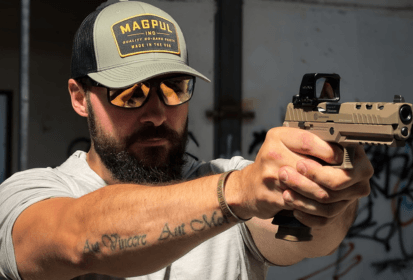
A consistent draw and pistol presentation help bring the red dot naturally into view without unnecessary searching or correction. Photo: Rigad
Beyond Dry Fire: Simunition FX and UTM
Simunition FX and UTM sit at the edge of dry-fire training because they allow realistic force-on-force scenarios using low-energy marking ammunition. Unlike dry fire, the firearm actually cycles, the shooter feels the shot, and hits can be assessed immediately. This is not home practice or a cheaper substitute for the range.
Marking ammunition is used in firearms fitted with the appropriate conversion or in dedicated training weapons.The conversion also reduces the risk of firing live ammunition. It does not, however, replace strict safety procedures, complete separation of live ammunition, or thorough equipment checks before training.
Neither Simunition FX nor UTM is harmless. Force-on-force training must take place in a controlled environment, under qualified supervision, and with the required protective equipment, especially for the eyes, face, neck, and other vulnerable areas. Because of the cost of conversions, training weapons, protective gear, and ammunition, these systems are used mainly by military and law-enforcement units and specialized training providers.
From personal experience, I also know that storage can affect FX ammunition. If cartridges remain stored on their side for long periods, the marking compound may settle unevenly inside the plastic projectile, affecting balance and accuracy. Training ammunition therefore also requires proper storage and inspection before use.
Dry Fire Only Works When It Has Structure
Dry-fire training makes it possible to practice specific shooting skills more often than range visits alone would allow. It does not replace live fire, recoil, or the real behavior of the firearm. Skills developed dry must therefore be tested regularly on the range and adjusted according to the results.
What matters is not the number of trigger presses but the quality of each repetition. Without a clear objective, deliberate execution, and feedback, the shooter may simply reinforce bad habits. A few focused minutes performed regularly are more useful than a long session of mindless clicking.
Safety requires the same discipline. Clearing the firearm, removing live ammunition, and maintaining a safe direction must come before every session, regardless of experience.
Good dry fire is not simply pressing the trigger on an unloaded gun.
It is structured training with a clear goal, defined procedure, and non-negotiable safety rules.


Readers are further interested