- Outdoor Clothing and Footwear

- All in the category Outdoor Clothing and Footwear
- Footwear

- Jackets

- Military Blouses

- Pants

- Functional clothing

- Sweatshirts

- Shirts

- Hawaiian & Lifestyle Shirts

- T-Shirts

- Shorts and Bermuda

- Overalls

- Caps and head coverings

- Gloves

- Socks

- Belts

- Suspenders

- Scarves, shawls, neckwear

- Raincoats, ponchos

- Women's clothing

- Children's clothing

- Clothing Care and Maintenance

- Patches & Insignia

- Vests

- Camping & Hiking

- All in the category Camping & Hiking
- Backpacks

- Bags, Cases & Waist Packs

- Sleeping in nature

- Cookers, grills

- Lighting a fire

- Outdoor Dishes and Tableware

- Dining in nature (Food for the journey)

- Survival kit

- Compasses

- Climbing equipment

- Flashlights

- Camping furniture

- Eye-glasses

- Telescopes

- Hydration

- Water purification

- Small Equipment and Essentials for Survival

- Electronics and accessories for mobile phones

- Watches

- Cases

- Paracords

- Wallets

- Towels

- Solar showers

- Waterproof notebooks

- Mosquito and Insect Protection

- Foot, hand, and body warmers

- Repair Kits and Adhesive Tapes

- Boating equipment

- Health, protection

- Tactical Gear

- All in the category Tactical Gear
- Plate Carriers and Tactical Accessories

- Load-bearing harnesses

- Tactical vests

- Tactical cases and pockets

- Ballistic protection

- Hearing protection

- Protection

- Tactical and military backpacks

- Tactical and combat belts

- Tactical Eyewear

- Flashlights for soldiers and police

- Helmets, coverage

- Camouflage

- Gas masks and protective equipment

- Medical equipment

- Boxes, cases

- Battering rams, crowbars

- Gear for dogs

- Shooting Gear

- All in the category Shooting Gear
- Shooting Glasses

- Weapon bags

- Shooting gloves

- Gun Cases

- Weapon Slings

- Optical sights

- Rangefinders

- Gun flashlights and lasers

- Cleaning, maintenance

- Gun waist bags

- Shooting bags

- Shooting mats

- Boxes and cases for ammunition

- Training equipment for shooting

- Bullet traps

- Speed loaders

- Knives and Tools

- Self-defence

- Firearms and Ammunition

- Other

- By interest


The Evolution of SIG Sauer: From the P210 to the P365 and MCX
Do you own a SIG firearm—or perhaps a Sauer hunting rifle? And where, exactly, does SIG Sauer fit into the picture? The names can be confusing. To make sense of them, we need to examine the relationship between the original Swiss SIG, Germany’s Sauer, and the modern American firearms manufacturer. The story begins with railway cars, passes through landmark service pistols such as the P210 and P220, and leads to today’s P365, MPX, and MCX platforms.
The Roots of SIG: From Railway Cars to Firearms
SIG and Sauer began as entirely separate companies with little in common. SIG was founded in 1853 in Neuhausen am Rheinfall, near Schaffhausen, Switzerland, by Conrad Neher, Heinrich Moser, and Friedrich Peyer im Hof. The company originally operated under the name Schweizerische Waggonfabrik.
That name lasted only a few years. During its early period, the company concentrated primarily on manufacturing railway rolling stock, before turning its attention to firearms in the early 1860s.
One of its first major military contracts involved the Prélaz-Burnand rifle, adopted as the Infanteriegewehr M1863. The contract permanently changed the direction of the engineering company. In 1863, it adopted the name Schweizerische Industrie-Gesellschaft—better known by the initials SIG.

SIG Sauer’s pistol story did not end with the legendary P210 and P220. The modern lineup is represented here by the black-and-gold P211-GTO SPECTRE COMP. Photo: Rigad
SIG in the 20th Century
SIG’s firearms business expanded rapidly after 1900, during a century defined by near-constant tension across Europe. Switzerland remained neutral throughout both world wars, and its arms industry escaped the widespread destruction suffered by manufacturers elsewhere—most notably in neighboring Germany.
Swiss neutrality did not prevent private companies from exporting weapons. Even so, SIG’s domestic market remained particularly important during the Second World War. With war raging beyond the country’s borders, Switzerland had every reason to strengthen its defenses. Its armed forces required modern weapons capable of deterring any potential aggressor.
The design lineage of one of SIG’s most iconic firearms began in the 1930s with the work of Charles Gabriel Petter. The new Swiss service pistol drew in part on his earlier Modèle 1935A, developed for and adopted by the French military.
SIG P210: A Service Pistol with Match-Grade Accuracy
The SIG P210 established the company’s reputation for high-quality service pistols and remains in production today. It is a single-action 9mm Luger pistol fed from a conventional single-stack magazine. On paper, that specification may not sound especially remarkable. In practice, the P210 combined two worlds more successfully than almost any service handgun before or since.
Known in Swiss service as the Pistole 49, the P210 delivered exceptional shooting characteristics, outstanding mechanical accuracy, and a superb trigger pull. Yet this was not a purpose-built competition pistol. It was a military sidearm, adopted not only by Switzerland but also by Denmark as the M/49 and by several organizations in what was then West Germany.
There is also a design detail of particular interest to Czech shooters. The SIG P210 uses internal slide rails—an arrangement later made famous by the CZ 75. Instead of wrapping around the outside of the frame rails, the slide runs inside the frame. Combined with precise machining, tight tolerances, and extensive bearing surfaces, this layout contributes to the pistol’s exceptionally smooth operation and high inherent accuracy.
SIG’s Postwar Development
In the years immediately following the Second World War, arms manufacturers around the world accelerated the development of assault rifles. The effectiveness of Germany’s Sturmgewehr 44 left little doubt that the traditional infantry rifle was about to undergo a fundamental transformation. Engineers in Neuhausen reached the same conclusion.

The modular P320 belongs to a modern generation of SIG Sauer pistols built on the brand’s long firearms heritage. Pictured here is the SIG Sauer P320 XFIVE DH3 equipped with a Holosun red dot sight. Photo: Rigad
SIG SG 510, Better Known as the Sturmgewehr 57
During the 1950s, SIG developed the rifle that would enter Swiss military service as the Sturmgewehr 57. On the commercial market, it became known as the SIG SG 510. The new rifle finally allowed Switzerland to replace the various Schmidt–Rubin-pattern rifles that had served its armed forces from the late 19th century into the mid-1950s.
Back to the Stgw. 57 itself. Few rifles embody the Swiss approach to firearms design quite so completely. The emphasis on quality, precision, and meticulous engineering is evident throughout the weapon.
The SIG SG 510 has an unmistakable silhouette. Its roller-delayed blowback operating system drew on earlier German designs, but the Swiss adapted the rest of the rifle around their own requirements. Fine aperture sights, exceptional workmanship, and high-grade materials quickly earned the confidence of soldiers. A number of carefully considered features further reinforced the rifle’s emphasis on precision.
A folding bipod, long barrel, and straight-line layout with the bore aligned closely with the stock all contributed to the rifle’s stability. These characteristics also explain why the platform remains popular for precision target shooting. Another distinctive feature is its winter trigger, which allowed the rifle to be fired while wearing heavy gloves. Some shooters also use it as an aid during deliberate precision fire.
These qualities—and many others—helped soldiers forgive the rifle’s considerable weight. Carrying a 5.7 kg service rifle is not for everyone. Many modern assault rifles in their basic configuration weigh little more than half as much.


SIG Sauer P220: The Beginning of a New Pistol Line
The next major breakthrough in SIG’s history came in 1975 with the introduction of the P220. Adopted by the Swiss military as the Pistole 75, it established the foundation for an entire family of successful service pistols.
You have probably heard the term “Wonder Nine.” If not, our earlier article on the subject is worth a look. These high-capacity 9mm pistols, typically combining a double-action/single-action trigger with a double-stack magazine, swept through the handgun market in the mid-1970s. Beretta introduced the Model 92, Smith & Wesson had the Model 59, and anyone who forgot our beloved CZ 75 owes us five push-ups.
The P220 became the direct predecessor of SIG Sauer’s later Wonder Nine, the P226. You may also have noticed that the Sauer name has finally entered the story. During the 1970s, SIG established a relationship with J. P. Sauer & Sohn, a manufacturer of sporting rifles based in Eckernförde, West Germany. In 1976, SIG acquired 90 percent of the company’s share capital.
The decision was entirely pragmatic. Producing pistols in West Germany made international sales easier, while Swiss export restrictions complicated shipments from SIG’s home country. The arrangement opened markets that had previously been difficult or impossible for the company to reach.
The SIG Sauer P220 already displayed the defining features of the later—and still familiar—P226, P228, and P229. Its construction relied heavily on stamped components. This was most apparent in the slide, which on early versions was formed from sheet steel and fitted with a separate breech block. The design reduced manufacturing costs while increasing production capacity. SIG Sauer later returned to machined-slide construction, but in the mid-1970s the stamped assembly represented an advanced manufacturing solution.
The pistol was also highly modern for its time. A rotating takedown lever simplified field stripping, while a decocking lever on the left side of the frame allowed the shooter to lower the hammer safely. The slide catch was positioned nearby. Early versions used a heel-mounted magazine release at the base of the grip, while later variants adopted a conventional push-button release behind the trigger guard.
The P22x family earned a strong international reputation for build quality, reliability, and dependable operation under demanding conditions.
SIG did not spend the 1980s developing handguns alone. Work also continued on the company’s long-gun portfolio. The Stgw. 57 was becoming increasingly dated, and the Swiss military needed a successor.

SIG Sauer’s classic hammer-fired P22x pistols were later joined by modern designs such as the P320 and P365. The compact P365 represents one of the defining platforms in the company’s current handgun lineup. Photo: Rigad
SIG SG 550 and the Sturmgewehr 90
What happens when you cross the AK operating system with a Swiss watch? You get the SIG SG 550. That description is deliberately simplified, of course, but it captures the basic idea surprisingly well.
By the 1960s and 1970s, military experience had demonstrated the advantages of smaller-caliber, high-velocity cartridges in modern assault rifles. The United States—and later NATO—standardized around the 5.56 × 45 mm cartridge, while the Eastern Bloc responded with the 5.45 × 39 mm. Switzerland belonged to neither alliance, but reached the same practical conclusion. Its full-power 7.5 × 55 mm Swiss service cartridge would give way to a lighter, more modern small-caliber round.
That transition required a new rifle. The goal of allowing soldiers to carry more compact, lightweight ammunition made little sense if they still had to haul around the exceptionally heavy Stgw. 57.
At some point, SIG’s engineers in Neuhausen may well have decided that the Soviet AK system had the right functional foundations—it simply needed to be “Swissified.” The result was an entirely new rifle using a similar long-stroke gas piston rigidly connected to the bolt carrier. Like its predecessors—and the Soviet rifle that influenced its operating system—the design made extensive use of stamped-steel components. Even so, the finished weapon retained every hallmark of high-grade Swiss engineering. Hence the comparison to a Swiss watch.
The rifle entered service in 1990 as the Sturmgewehr 90, and derivatives soon found users far beyond Switzerland. Various members of the SG 55x family were adopted by military and law-enforcement units around the world, including France’s GIGN, Germany’s GSG 9, and the FBI in the United States. The platform also serves with the Pontifical Swiss Guard responsible for protecting the Pope.


SIG Sauer in the United States: From SIGARMS to Today
Like its competitors, SIG recognized that the United States represented the critical market for any major small-arms manufacturer—both in the civilian sector and among military and law-enforcement customers.
SIGARMS was established in Virginia in 1985 and later relocated to New Hampshire. The operation began by importing the SIG P220 and P230, followed by models such as the P225, P226, and P228. Over time, European imports were supplemented by domestic manufacturing. In 2007, SIGARMS became SIG Sauer Inc. The company subsequently expanded beyond firearms into suppressors, ammunition, optics, and airguns.
The Swiss arm of the business continued independently. It became SAN Swiss Arms AG in 2000 and has operated as SIG SAUER AG since 2020.
Another major turning point came in 2020, when production ended at the German SIG Sauer GmbH & Co. KG facility in Eckernförde. Meanwhile, the American operation continued to expand at a remarkable pace.
One of the U.S. company’s most significant achievements was convincing American customers to view SIG Sauer as an almost domestic brand. In doing so, it managed to challenge—and in several segments outmaneuver—some of the country’s most established firearms manufacturers.

SIG Sauer’s American chapter brought major military contracts as well as a broader civilian portfolio. The diversity of that lineup is reflected in the P365 family, represented here by the ROSE configuration. Photo: Rigad
Military Contracts: From the M17 and M18 to NGSW
One of SIG Sauer’s most significant victories came in 2017, when its entry won the U.S. Army’s competition for a new service pistol. Developed from a modified P320 platform, the resulting M17 and M18 defeated submissions from established competitors including Beretta and Glock. It was a major contract—and SIG Sauer had no intention of stopping there.
The company scored another major win in 2022 with the Next Generation Squad Weapon program. The U.S. Army was seeking replacements for portions of its M4 carbine- and M249 light machine gun-based inventory. The program produced the M7 rifle, M250 automatic rifle, and the new 6.8 × 51 mm cartridge. A commercial version of the ammunition is marketed as the .277 SIG Fury.
Development has continued. In 2026, the U.S. Army approved the transition from the M7 rifle to the shorter, lighter XM8 carbine—a revised configuration shaped by operational testing and direct soldier feedback. Article
SIG Sauer P320 and P365: Modularity Moves into the Mainstream
The civilian market was hardly overlooked. Alongside the traditional hammer-fired P22x family, SIG Sauer introduced the modern P320 and the slimline P365 series. Both platforms are available in an extensive range of configurations, covering everything from concealed carry to duty and competition use.
Much of that adaptability comes from the removable Fire Control Unit, or FCU. Under U.S. law, this serialized chassis is the legally controlled firearm component. Within the appropriate model family, it can be transferred between compatible grip modules and paired with different slide-and-barrel assemblies.
SIG MPX: A Gas-Operated PCC
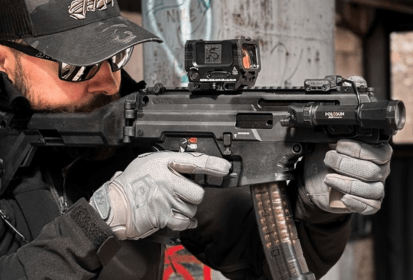
SIG Sauer entered the pistol-caliber carbine market in force with the MPX. Its controls and overall layout draw heavily from the AR-15, but its operating system sets it apart from most PCCs.
Rather than relying on the simple blowback action common to the category, the MPX uses a locked, rotating bolt driven by a short-stroke gas piston. It is an arrangement more commonly associated with rifle-caliber weapons—and a distinctly unconventional choice for a 9mm platform.

Each SIG Sauer product family has its own handling characteristics. Beyond specifications, the right choice depends on ergonomics, control placement, and how naturally the handgun fits the shooter’s hand. Photo: Rigad
SIG MCX: An AR-Style Rifle Without a Buffer Tube
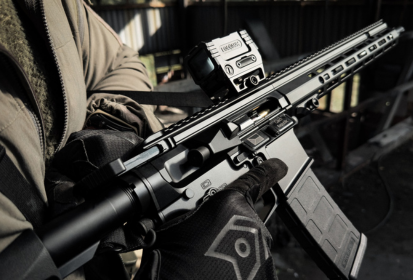
Alongside the MPX, the SIG MCX deserves particular attention. At first glance, it appears to be yet another AR-15 derivative. That assessment is both right and wrong. SIG Sauer addressed one of the AR platform’s key design constraints: its dependence on a receiver extension, commonly known as the buffer tube.
In a conventional AR-15, the recoil spring and buffer are housed inside a tube extending behind the lower receiver. This arrangement prevents the use of a true side-folding stock. The MCX relocates its recoil assembly inside the upper receiver, allowing SIG Sauer to retain familiar AR-style ergonomics while moving the overall concept in a more compact and adaptable direction.
Which SIG Sauer Is Right for You?
SIG Sauer’s history explains why such different firearms now share the same name. From traditional service pistols to the modular P320 and P365, and onward to the MPX and MCX, each product family has a distinct character and intended role. Choosing between them begins with a clear understanding of what you expect the firearm to do.
Explore the SIG Sauer firearms and accessories available from Rigad, or visit one of our stores to handle the company’s products in person. You may discover that one of them belongs in the category of things you suddenly—and absolutely—need.






Readers are further interested