

- Outdoor Clothing and Footwear

- All in the category Outdoor Clothing and Footwear
- Footwear

- Jackets

- Military Blouses

- Pants

- Functional clothing

- Sweatshirts

- Shirts

- Hawaiian & Lifestyle Shirts

- T-Shirts

- Shorts and Bermuda

- Overalls

- Caps and head coverings

- Gloves

- Socks

- Belts

- Suspenders

- Scarves, shawls, neckwear

- Raincoats, ponchos

- Women's clothing

- Children's clothing

- Clothing Care and Maintenance

- Patches & Insignia

- Vests

- Camping and hiking

- All in the category Camping and hiking
- Backpacks

- Bags, satchels, suitcases, waist bags

- Sleeping in nature

- Cookers, grills

- Lighting a fire

- Outdoor Dishes and Tableware

- Dining in nature (Food for the journey)

- Survival kit

- Compasses

- Climbing equipment

- Flashlights

- Camping furniture

- Eye-glasses

- Telescopes

- Hydration

- Water purification

- Small Equipment and Essentials for Survival

- Electronics and accessories for mobile phones

- Watches

- Cases

- Paracords

- Wallets

- Towels

- Solar showers

- Waterproof notebooks

- Mosquito and insect protection

- Foot, hand, and body warmers

- Repair Kits and Adhesive Tapes

- Boating equipment

- Health, protection

- Tactical Gear

- All in the category Tactical Gear
- Plate Carriers and Tactical Accessories

- Load-bearing harnesses

- Tactical vests

- Tactical cases and pockets

- Ballistic protection

- Hearing protection

- Protection

- Tactical and military backpacks

- Tactical and combat belts

- Tactical Eyewear

- Flashlights for soldiers and police

- Helmets, coverage

- Camouflage

- Gas masks and protective equipment

- Medical equipment

- Boxes, cases

- Battering rams, crowbars

- Gear for dogs

- Shooting Supplies

- All in the category Shooting Supplies
- Shooting Glasses

- Weapon bags

- Shooting gloves

- Weapon cases

- Weapon Slings

- Optical sights

- Rangefinders

- Gun flashlights and lasers

- Cleaning, maintenance

- Gun waist bags

- Shooting bags

- Shooting mats

- Boxes and cases for ammunition

- Training equipment for shooting

- Bullet traps

- Speed loaders

- Knives and Tools

- Self-defence

- Firearms and Ammunition

- Other

- By interest


How to Choose the Right Handgun Size for Concealed Carry
Full-size, compact or subcompact? When choosing a handgun for concealed carry, size is only part of the equation. Carry comfort, handling, accuracy and reliability matter just as much.
Under current Czech law, anyone with an extended firearms authorization may carry a concealed firearm to protect life, health and property. With a touch of humor, carrying a handgun is certainly less demanding than bringing a police officer along—particularly given their size, weight and limited availability.
The choice of a defensive handgun, and especially its size, is the subject of endless debate. Sound reasoning mixes with gut feelings, hard-earned experience and regret over choosing the wrong model or size.
At one end are committed full-size handgun advocates. At the other are those who follow the “smallest possible handgun in an effective caliber” philosophy. This article is not intended to criticize either approach or identify a single ideal handgun size.
Instead, I want to share some of the personal experience I gained while searching for “the one.” It may highlight factors that prospective defensive handgun owners have yet to consider—factors that are difficult to recognize without first-hand experience and, quite often, several purchases made with your own money.

A concealed carry handgun must provide an acceptable balance between carry comfort and shootability. Photo: Rigad
What Handgun Sizes Are Used for Concealed Carry?
Size categories are not entirely consistent across manufacturers. For general reference, however, handguns can be divided into the following groups:
- Full-size: A duty-size handgun better suited to open carry in an outside-the-waistband holster, typically by law enforcement or military personnel. It can still be carried concealed, but doing so requires the right holster, belt and clothing. Examples include the CZ P-10 F with a 19-round magazine, the Glock 17/47 with a 17-round magazine and the HS SF19 with a 19-round magazine.
- Compact: A handgun designed for easier concealment by shortening the barrel, slide and grip. This usually results in a modest reduction in magazine capacity. Examples include the CZ P-10 C and Glock 19, both with 15-round magazines.
- Subcompact: A further-reduced handgun intended to make concealed carry easier while retaining acceptable handling characteristics. Magazine capacity is generally lower than on compact models. Examples include the CZ P-10 S with a 12-round magazine, the Glock 26 with a 10-round magazine and the subcompact version of the HS-9 G2 with a 13-round magazine.
- Semicompact/Crossover: A handgun combining a frame and slide from different size categories. One configuration pairs a compact-length slide and barrel with a full-size frame, as seen on the Glock 19X/45 and the discontinued CZ 75 Semicompact. The reverse layout uses a compact frame with a full-size slide and barrel, as on the CZ P-10 SC. In the first configuration, magazine capacity remains comparable to a full-size handgun because the grip retains its full length.
- Slimline: A handgun with a narrower slide and frame in addition to reduced overall dimensions. Instead of a conventional double-stack magazine, it may use a single-stack or staggered-stack design. Typical examples include the discontinued CZ P-10 M, the Glock 43/43X/48 and the HS Produkt H11.
At the smallest end of the spectrum is the micro-compact category. This term generally describes very small, narrow handguns designed primarily for concealed carry. The boundaries between subcompact, micro-compact and slimline pistols are not clearly defined, however, and manufacturers use these terms differently.

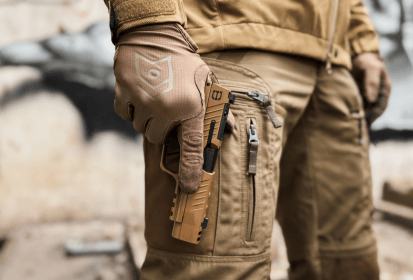
Handgun size, holster design and carry position all affect comfort, concealment and access to the firearm. Photo: Rigad
Handgun Size: Carry Comfort vs. Shootability
To begin, imagine a scale with “carry comfort” at one end and “shootability” at the other. Any handgun can be placed somewhere between these two extremes. As a general rule, the closer your choice moves toward carry comfort, the further it moves away from shootability—and vice versa.
The purpose of this scale is to help each shooter identify the largest handgun they are willing to carry concealed on a daily basis, while also finding the smallest handgun with which they can still achieve an acceptable level of shooting performance. The ideal concealed carry handgun is therefore highly subjective.
It is a handgun that remains comfortable enough to carry without reducing shooting performance below the level acceptable to its particular user.
Why Larger Handguns Are Usually Easier to Shoot
To use two of the best-known brands as examples, most shooters would agree that a Glock 17/47 or CZ P-10 F is considerably easier to shoot than a Glock 26 or CZ P-10 S.
The difference becomes apparent when establishing a grip on the holstered handgun, drawing, chambering a round if necessary, bringing the handgun onto the target while building a solid two-handed grip, acquiring the sights, firing and controlling the handgun during rapid follow-up shots. In all these areas, the size and length of the grip—and therefore the amount of contact between the handgun and the shooter’s hand—play an important role.
For a simplified comparison, assume that all handgun sizes are fired with the same ammunition, such as a 9×19 mm load using a 115-grain bullet. The handgun’s response to the shot depends partly on its weight: with the same caliber and a comparable force acting on it, a heavier handgun accelerates less. The shooter’s perception of recoil is also affected by the area of the grip in contact with the hand. The smaller that contact area, the sharper the recoil may feel.
This is particularly noticeable with the popular Glock Slimline models—the Glock 43, 43X and 48. Their lower weight, narrower backstrap and smaller gripping surface make their recoil feel more pronounced. As one anonymous shooter at the range aptly put it, they are “snappier,” especially the Glock 43. After all, there is simply less handgun in your hand.
How Handgun Size Affects Concealed Carry Comfort
From the perspective of carry comfort, however, the assessment is logically reversed. A Glock 43 can be so unobtrusive that you may occasionally feel the need to check that it is still where you carry it.
As a general rule, the larger the handgun, the more noticeable it becomes during carry and the more it interferes with everyday activities. You also have to pay closer attention to prevent it from printing or becoming unintentionally exposed when moving or changing position. Carrying a larger handgun may therefore require adjustments to your wardrobe—such as investing in a few loose-fitting beach shirts for the summer.


There have also been advocates of carrying significantly larger handguns, such as the Desert Eagle in .50 AE or revolvers chambered in .500 S&W Magnum or .454 Casull. For everyday carry, however, this is clearly an exercise in masochism. The high cost of ammunition and substantial recoil also make regular, high-volume training with these calibers considerably more difficult.
Not every handgun dimension has the same impact on concealability. Grip length is usually the most critical. It is the grip that creates the tell-tale bulge, whether the handgun is carried at the three o’clock position or in the appendix position. A properly shaped and positioned holster can reduce printing caused by a longer grip to some extent.

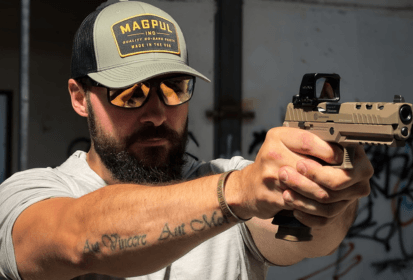
A larger handgun generally provides more room for a secure two-handed grip and better control during rapid fire. Photo: Rigad
How Handgun Size Affects Performance in a Defensive Encounter
A Larger Grip Is Easier to Establish Under Stress
A defensive handgun must be gripped securely not only at speed, but also under the psychological pressure of a real-world confrontation. Acute stress can impair fine motor skills, reduce tactile sensitivity and make it harder to establish a precise, consistent grip. As a general rule, a larger grip gives the hands more room and makes a secure hold easier to achieve. The result will always depend on the shooter’s physical characteristics, as well as the quality and frequency of their training.
Support-hand placement also affects grip quality and, ultimately, the ability to hit the target. The less space the grip provides, the harder it is to position both hands correctly. A simple analogy applies: parking the same car accurately becomes more difficult as the parking space gets smaller.
Accuracy with a Small Handgun
Handgun size can also have a significant effect on accuracy. Over time, I carried and trained with a Glock 42, Glock 43 and Glock 48. With none of them could I come close to the results I achieved with a Glock 19 or Glock 17.
Because of the grip dimensions, trigger characteristics and especially the narrow backstrap, my hand never seemed to find a grip that produced acceptable accuracy—even after several years of trying to make these pistols work for me. The notable exception was the now-discontinued CZ P-10 M. Despite a trigger pull of around 50 N, it allowed me to achieve results comparable to those from the CZ P-10 S, P-10 C and P-10 F.
“But accuracy is not that important. Most defensive shootings happen inside ten meters…” I hear this argument often. But if someone cannot achieve an acceptable level of accuracy at 25 meters under controlled conditions—a distance at which shooting errors become more visible and easier to diagnose—how can they be confident of making the hit at seven meters when stress, a compromised grip and adrenaline-induced tremors enter the equation, particularly with bystanders nearby?
Small Handguns Are More Sensitive to Grip Technique
Reliability under less-than-ideal conditions is another consideration. One experience permanently ruled out the Glock 42 for me. This locked-breech pistol chambered in 9 mm Browning Court (.380 Auto) proved extremely sensitive to wrist rigidity. Whenever I relaxed my wrist, it would almost invariably malfunction—either trapping the extracted case in the ejection port or failing to feed the next round into the chamber.
When the wrist was allowed to move, the frame travelled rearward with the slide. This reduced the slide’s velocity relative to the frame and left insufficient energy to complete the operating cycle, resulting in a malfunction. In a defensive encounter, stance and grip are already unlikely to be ideal. Deliberately adding a handgun that is unusually sensitive to wrist rigidity was therefore a variable I was unwilling to accept.
A smaller handgun may be more susceptible to this problem when the shooter’s grip is compromised under stress. Other owners of small defensive pistols have also confirmed that grip quality plays a much greater role with smaller handguns than with larger models. Malfunctions are generally easier to clear on a larger handgun as well, particularly because the frame and slide provide more surface area to grasp and manipulate.

Regular practice with an everyday carry handgun should include drawing, weapon handling and live fire. Photo: Rigad
A Carry Handgun Must Be Practical to Train With
If you carry a handgun for self-defense, you should practice with it regularly, shoot it often enough to build genuine familiarity and maintain the skills you have developed.
Yet when I ask people how often they actually train with their carry handgun, the answer is frequently, “Honestly, not very often.” The reasons may include ammunition costs, repetitive training routines, frustration with poor shooting results or an unwillingness to admit that the handgun may have been the wrong choice after all.
Whether someone is willing to train regularly with a particular handgun depends on several factors:
- the cost and availability of suitable ammunition,
- recoil intensity and fatigue during longer range sessions,
- grip size and shape in relation to the shooter’s hand,
- accessibility of the controls and ease of manipulation,
- trigger and sight characteristics,
- the ability to achieve satisfactory, repeatable results,
- reliability with a less-than-ideal grip,
- the availability of magazines, a suitable holster and other equipment required for training.
A handgun may be easy to conceal yet unpleasant, difficult or frustrating to shoot. That does not necessarily make it a good choice for everyday carry. If its characteristics discourage regular training, the advantage of its small size can quickly become a liability.
A suitable defensive handgun must therefore be comfortable enough for all-day carry, but also manageable enough that its owner is both willing and able to train with it consistently.
Find the Right Balance When Choosing Handgun Size
When selecting a handgun for concealed carry, follow a simple rule: it should be no larger than you can comfortably carry all day, yet no smaller than you can reliably control and shoot to an acceptable standard.
The right size is determined not merely by the manufacturer’s category, but by the individual user, the chosen carry method and the results achieved in regular training.
The best choice is neither the smallest handgun you can conceal nor the largest handgun you can shoot well. It is the one you will actually carry—and train with regularly.


Readers are further interested