

- Outdoor Clothing and Footwear

- All in the category Outdoor Clothing and Footwear
- Footwear

- Jackets

- Military Blouses

- Pants

- Functional clothing

- Sweatshirts

- Shirts

- Hawaiian & Lifestyle Shirts

- T-Shirts

- Shorts and Bermuda

- Overalls

- Caps and head coverings

- Gloves

- Socks

- Belts

- Suspenders

- Scarves, shawls, neckwear

- Raincoats, ponchos

- Women's clothing

- Children's clothing

- Clothing Care and Maintenance

- Patches & Insignia

- Vests

- Camping & Hiking

- All in the category Camping & Hiking
- Backpacks

- Bags, Cases & Waist Packs

- Sleeping in nature

- Cookers, grills

- Lighting a fire

- Outdoor Dishes and Tableware

- Dining in nature (Food for the journey)

- Survival kit

- Compasses

- Climbing equipment

- Flashlights

- Camping furniture

- Eye-glasses

- Telescopes

- Hydration

- Water purification

- Small Equipment and Essentials for Survival

- Electronics and accessories for mobile phones

- Watches

- Cases

- Paracords

- Wallets

- Towels

- Solar showers

- Waterproof notebooks

- Mosquito and Insect Protection

- Foot, hand, and body warmers

- Repair Kits and Adhesive Tapes

- Boating equipment

- Health, protection

- Tactical Gear

- All in the category Tactical Gear
- Plate Carriers and Tactical Accessories

- Load-bearing harnesses

- Tactical vests

- Tactical cases and pockets

- Ballistic protection

- Hearing protection

- Protection

- Tactical and military backpacks

- Tactical and combat belts

- Tactical Eyewear

- Flashlights for soldiers and police

- Helmets, coverage

- Camouflage

- Gas masks and protective equipment

- Medical equipment

- Boxes, cases

- Battering rams, crowbars

- Gear for dogs

- Shooting Gear

- All in the category Shooting Gear
- Shooting Glasses

- Weapon bags

- Shooting gloves

- Gun Cases

- Weapon Slings

- Optical sights

- Rangefinders

- Gun flashlights and lasers

- Cleaning, maintenance

- Gun waist bags

- Shooting bags

- Shooting mats

- Boxes and cases for ammunition

- Training equipment for shooting

- Bullet traps

- Speed loaders

- Knives and Tools

- Self-defence

- Firearms and Ammunition

- Other

- By interest


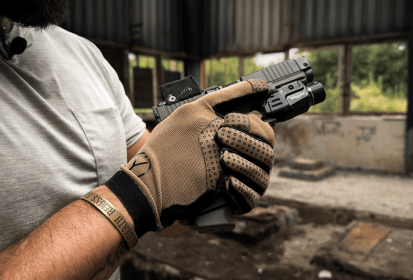
Choosing the Right Tactical Gloves for the Job
The first question when choosing tactical gloves is not which model is best, but what job the gloves must perform. Shooting calls for precise fit and maximum tactile feedback. Tool work and movement over obstacles place greater emphasis on palm durability, reinforcement, and knuckle protection. Cold, wet conditions, and cut hazards introduce further requirements that a general-purpose tactical glove may not meet. This article examines the major design features, their practical effect, and specific models suited to different applications.
The term tactical glove covers a surprisingly broad range of designs. Some are lightweight and close-fitting, while others use reinforced palms, impact padding, or prominent knuckle guards. The difference is not limited to protection. It also affects how precisely the wearer can operate a firearm, handle equipment, or work with tools.
Palm material and thickness determine both tactile feedback and abrasion resistance. TPR and D3O protectors help shield the back of the hand and knuckles, grip treatments improve purchase, and finger patterning determines whether the glove supports fine manipulation or gets in the way. Cuff design, closure type, breathability, and the placement of reinforced panels all play a role as well.
None of these features is automatically beneficial in every application. A thicker palm withstands more abuse but reduces feel. A larger knuckle protector offers more coverage while adding bulk. The correct starting point is therefore the task itself: what the wearer must do in the gloves, and which hazards the hands actually need protection from.

The Mechanix M-Pact combines TPR back-of-hand protection with D3O palm padding. This construction is well suited to tool work and hard-use handling, but may add unnecessary bulk for precise trigger manipulation. Photo: Rigad
Start with the Intended Use
What Will You Be Doing in the Gloves?
Identify the task that places the greatest demands on the glove. In tactical and action shooting, the priority is safe, consistent weapon handling: operating the trigger and controls, conducting reloads, clearing malfunctions, and, where applicable, transitioning between rifle and pistol. Precise fit, a thin palm, and unrestricted movement of the trigger finger are critical.
Personnel, baggage, and vehicle searches require tactile sensitivity, but may also call for protection against cuts or punctures. These are separate protective properties, and standard duty gloves do not necessarily provide either one.
Tool work, forced entry, and obstacle negotiation place greater demands on palm durability, abrasion resistance, and impact protection. Lightweight shooting gloves may preserve excellent feel, but generally do not provide enough protection for this level of abuse.
Also consider the tasks repeated throughout duty or training: driving, operating a radio or flashlight, applying handcuffs, handling medical supplies, and using a touchscreen. If every small control requires removing a glove, that glove is poorly matched to the rest of the equipment setup.
Conditions, Hazards, and Required Dexterity
Temperature, duration of wear, exposure to water and contaminants, and the surfaces being handled all matter. During high-intensity training in warm conditions, breathable panels across the back of the hand and between the fingers help manage heat and moisture without weakening the high-wear palm area.
Rain, mud, and wet equipment require a palm material that retains its shape and provides usable grip when saturated. Extended exposure to cold calls for insulation, wind protection, and a cuff that interfaces properly with the sleeve.
Assess injury hazards separately. Abrasion, knuckle impacts, cuts, punctures, contact heat, and a rope running rapidly through the hand all load the glove in different ways. If any of these hazards forms part of the task, look for a purpose-built construction and, where relevant, test results under the appropriate standard. The word durable in a product description does not distinguish between them.
The trigger is not the only measure of dexterity. Consider the smallest or least accessible component you must operate while gloved: a safety selector, radio control, buckle, zipper, or small item of medical equipment. The finer the task, the more palm thickness, finger length, and seam placement matter.

Segmented TPR panels protect the back of the hand and finger joints without forming a single rigid shell. When selecting a more robust tactical glove, verify that the protective elements remain in place and do not press against the knuckles when the hand closes. Photo: Rigad
Tactical Gloves by Application
Shooting and Dynamic Training
Shooting gloves should fit closely, with no excess material at the fingertips or across the palm. Desirable features include a thin, single-piece palm, an index finger without a prominent seam across the trigger-contact area, and flexible finger sidewalls. The high-wear web between the thumb and index finger may be reinforced, provided the reinforcement does not create a stiff point within the firing grip.
The MoG Target Combat is one example. It combines a 0.6 mm DexSuede palm with a close finger profile, silicone grip print, and D3O knuckle protection covered by stretch Cordura.
If back-of-hand protection is unnecessary and maximum tactile feedback is the priority, dedicated shooting gloves may be the better choice. One example is the Dýlejc Bivoj, whose low-profile construction, trigger-finger design, and placement of rubberized grip elements are examined in greater detail in our article Bivoj Dýlejc: Shooting Gloves Built for Dexterity and a Secure Grip.

Shooting gloves depend on precise finger fit, a thin palm, and carefully positioned seams. The MoG Target Combat uses a 0.6 mm DexSuede palm, while a flexible D3O insert protects the back of the hand. Photo: Rigad
Duty, Patrol, and Search Tasks
Patrol gloves are often worn for extended periods while the user alternates between handling a firearm, operating a vehicle and radio, and working with other equipment. The design therefore needs a supple palm, a breathable back, and reinforcement at the points exposed to repeated abrasion.
The Magpul Patrol 2.0, for example, combines goatskin leather with a stretch nylon back and foam knuckle padding. The First Tactical Lightweight Patrol also uses goatskin leather and a lightweight stretch back, while adding a cuff cutout for a wristwatch. The women’s version uses a revised anatomical pattern rather than simply offering the same glove in a smaller size.
For search duties, distinguish tactile sensitivity from verified protection. If contact with sharp edges or hypodermic needles is a realistic hazard, look specifically for cut resistance or needle-puncture resistance. A rating for one does not imply protection against the other, and general patrol gloves should not automatically be treated as providing both.
Tool Work, Obstacle Negotiation, and Breaching
Tool use, movement over abrasive obstacles, and forced entry place greater emphasis on palm durability, back-of-hand protection, and the ability to absorb pressure and vibration. The Mechanix M-Pact Covert combines TPR protection across the back of the hand with D3O padding in the palm.
The Wiley X Durtac uses a more substantial thermoplastic knuckle guard and a synthetic palm. Features of this type are valuable when mechanical protection is the priority, but they may add more bulk than necessary for fine trigger work.
If the task is dominated by assembly, material handling, or prolonged tool use, a dedicated work glove is generally the better choice. For law-enforcement and control duties requiring increased hand protection, look instead at purpose-built police and impact-protection gloves.
Wet and Cold Conditions
Tactical gloves intended for rain, mud, or work around water should retain their shape and grip performance when wet, then dry within a reasonable time. The MoG Frog 1.5 uses a 0.8 mm ArmaSuede palm with silicone grip print, a neoprene back, and low-profile TPR protection. It is designed for weapon and equipment handling in wet conditions, not as a waterproof glove.
True waterproofing requires a suitable membrane or another impermeable construction, which will generally reduce breathability and tactile feedback.

Low-profile TPR elements protect the backs of the fingers without significantly restricting the grip. The MoG Frog 1.5 is designed for weapon and equipment handling in wet conditions, but it is not a waterproof glove. Photo: Rigad
In cold conditions, both exposure time and activity level matter. Lightweight insulation and wind protection may be sufficient during dynamic training, but not during prolonged static duty. An overly tight glove can also compress the insulation and restrict circulation to the fingers. For extended use in low temperatures, choose a dedicated winter glove and verify that you can still operate your firearm and equipment safely.
Design Features and Their Practical Effect
Palm, Fingers, and Reinforcement
A thin, single-piece palm provides better tactile feedback than multiple layers and heavy padding. Goatskin leather is generally supple and resistant to routine wear. Synthetic materials allow manufacturers to control thickness, stretch, drying performance, and the placement of conductive touchscreen zones more precisely. What ultimately matters, however, is the complete construction: material thickness, number of layers, patterning, and seam placement.
Common reinforcement areas include the web between the thumb and index finger, the side of the index finger, the fingertips, and sections of the palm that contact tools. Reinforcement should protect high-wear surfaces without creating a ridge that presses into the hand under load. On shooting and patrol gloves, pay particular attention to the trigger finger. A side-mounted or offset seam is generally less intrusive than a heavy joint running directly across the finger pad.
TPR, D3O, and Knuckle Protection
Foam padding is low-profile and flexible, but it provides a different level of protection from a rigid guard. TPR—thermoplastic rubber—is commonly formed into flexible segments over the knuckles and finger joints. D3O remains pliable during normal movement and helps distribute impact energy when struck. A more rigid thermoplastic protector creates a stronger mechanical barrier, but adds bulk.
When the hand closes into a fist, the protector should remain centered over the knuckles. Its edges must not press against the bone or pull the fingers toward extension. Properly segmented TPR panels can interfere less with manipulation than a single rigid shell. The mere presence of a knuckle guard, however, says little about its actual protective performance. For duty use, check the relevant certification as well.
Grip Treatments
Silicone or rubberized print increases friction without adding another continuous layer of material. On a pistol, it works both between the palm and grip and between the fingers of the firing and support hands, making placement on the fingers relevant as well. For tools or wet equipment, performance depends on whether the pattern works against the specific surface being handled.
More grip print does not automatically produce a better grip. An overly aggressive treatment can impede rapid hand repositioning and will gradually wear with use. Correct placement and precise fit matter more. Even the most adhesive surface cannot compensate for a loose glove—the entire palm layer will simply shift against the hand.
Cuffs and Additional Features
An elastic cuff allows fast donning and eliminates a protruding adjustment strap. A hook-and-loop closure provides more precise adjustment, but adds material and collects dirt. Neoprene fits closely around the wrist and offers some cushioning, although it ventilates poorly in warm conditions. A short cuff generally interfaces more easily with a watch and sleeve, while a longer cuff provides greater wrist coverage.
Useful details include conductive touchscreen zones, an absorbent thumb panel, breathable finger gussets, a donning loop, and a watch cutout. Each addresses a specific practical issue, but none can compensate for poor fit. Excess material at the tip of the index finger will compromise touchscreen control even if the fabric itself is conductive.

A glove cuff must interface properly with a watch, sleeve, and other wrist-mounted equipment. The Frog 1.5’s neoprene cuff fits closely around the wrist, but its compatibility should still be tested with the complete equipment setup. Photo: Rigad
Protection Against Specific Hazards and Relevant Standards
Abrasion resistance is not the same as cut resistance. Cut protection does not automatically provide resistance to needle punctures, and a knuckle guard says nothing about how the palm will perform against contact heat or a rapidly moving rope. If a hazard is genuinely part of the task, broad labels such as tactical or protective are not enough.
For mechanical hazards, you may encounter testing under EN 388; protection against cold is covered by EN 511, while thermal hazards fall under EN 407. Always read the complete performance code and the documentation for the specific model. The standard number identifies the category of testing, not the level of protection achieved.
An X in a performance-code position does not indicate the highest rating. It generally means that the relevant test was not performed or was not applicable to that model. A 0, by contrast, usually means the test was conducted but the glove failed to reach the lowest classification level.
Terms such as Kevlar or impact-protective should be treated with the same caution. The material may be present in only part of the glove, while the protector may cover only a limited area. For professional use, the documented protection level and its actual coverage matter more than the most prominent word in the product name.
Testing Tactical Gloves with Your Own Equipment
Try the gloves on both hands. Spread your fingers, make a fist several times, and grip an object similar in diameter to a pistol grip or the handle of your usual tool. Your fingers should reach the ends without pressure against the nails. The palm should not form pronounced folds when closed, seams should not cut into the spaces between the fingers, and any protector should remain centered over the knuckles.
Where safe and practical, use a verified unloaded firearm and your own equipment to run through the normal sequence of tasks:
- placing the trigger finger inside the trigger guard and establishing contact with the trigger
- operating the safety or selector, magazine release, and slide stop
- removing and inserting a magazine
- operating a radio, flashlight, zippers, buckles, and medical equipment
- checking for interference between the cuff and a watch, sleeve, or forearm protector
For work applications, repeat the test with the actual tool involved. Poor fit reveals itself through excess material at the fingertips, movement of the palm layer, excessive resistance when closing the hand, a protector that shifts off the knuckles, or pressure and tingling in the fingers. If no available size fits both finger length and palm width, change the model or manufacturer. Glove sizing is not standardized across brands.
When More Than One Pair Is the Better Solution
Shooting, search duties, technical work, and cold-weather operations share some requirements, but their priorities differ. A lightweight pair may cover firearm and equipment handling, a more robust pair can be reserved for tools and obstacles, and an insulated pair used for prolonged cold exposure. You do not need a separate glove for every individual task—only for activities that demand conflicting characteristics.
When choosing tactical gloves, begin with the task, the specific hazards, and the smallest control or component you must manipulate. Only then compare palm materials, fit, knuckle protection, and additional features. The result should protect your hands without preventing you from performing the job for which the gloves were selected. That is a more useful benchmark than the number of technologies listed in the description—and usually more useful than the number of logos across the back of the hand.


Readers are further interested