



Sport Shooting
Hearing protection and reduced shooter fatigue during training thanks to lower noise levels and reduced recoil.


When most people hear the word suppressor, they imagine the Hollywood cliché — a whisper-quiet puff that makes gunfire vanish into silence. In reality, things are very different. Suppressors are not mere props for secret agents; they represent more than a century of engineering progress. Today, their purpose extends far beyond reducing sound: they play a crucial role in protecting hearing, lowering recoil, and improving overall shooting comfort.
The first known attempts to reduce the noise of gunfire date back to the late 19th century. In 1892, Swiss inventor Jakob Stahel patented a device originally designed for humane livestock slaughter but adaptable for firearms. Just two years later, fellow Swiss innovator C. A. Aeppli followed with a similar concept.
The true breakthrough came in 1905, when American designer Hiram Percy Maxim — son of the legendary machine-gun inventor Sir Hiram Maxim — secured a patent for what became known as the Maxim Silencer. This design was the first commercially successful suppressor and was actively promoted in sporting magazines. At the time, the emphasis was less on tactical use and more on civilian convenience: reducing noise for hunters and sport shooters and allowing firearms to be used without disturbing the surroundings.
The Second World War marked a turning point. Suppressors became tools of clandestine warfare, issued to operatives of the Office of Strategic Services (OSS) — the forerunner of today’s CIA. A favored weapon was the High Standard HDM pistol chambered in .22 LR, fitted with an integral suppressor. Compact, accurate, and quiet, it proved ideal for covert missions.
One of the most famous demonstrations of its effectiveness occurred in the White House itself. OSS Director William J. Donovan once presented the silenced pistol to President Franklin D. Roosevelt. After Roosevelt finished dictating a letter, Donovan calmly fired into a sandbag in the Oval Office, then handed the still-smoking pistol to the astonished president. The message was unmistakable: by the standards of the 1940s, suppressor technology was already remarkably advanced.

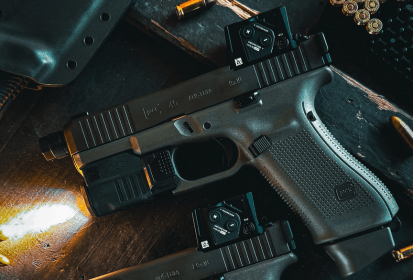
Silencer for a 9 mm pistol when shooting at a shooting range. Significantly increases comfort and protects the shooter's hearing.
Early suppressor development was full of clever — and sometimes impractical — experiments. Those designs taught engineers what not to do, and they shaped the durable, reliable suppressors we use today.
🔵 Contact-type suppressors (wipe or self-piercing designs)
One early idea was to line the bore end of the suppressor with a soft “wipe” (rubber, leather, or similar material). The bullet would pierce this material on the first shot, creating its own bore path. While the concept reduced blast for the opening shots, it had obvious drawbacks: the wipe wore out quickly, shot-to-shot repeatability and accuracy degraded, and the device typically survived only a handful of rounds before needing replacement. That short service life and the loss of precision made wipes useful only for very specific, limited-use scenarios.
🔵 Wet suppressors
Another historic approach was the “wet” suppressor: operators added a measured amount of liquid (water, oil, or a gel) into the expansion chambers. The liquid absorbed heat and condensed some combustion gases, lowering pressure and reducing noise — water was particularly effective. In practice, however, wet operation was messy and unreliable. Liquids either boiled away, leaked, or formed aerosols that fouled the suppressor and the host firearm. Under high rifle pressures and temperatures the effect vanished after very few shots, and oily residues created corrosion and maintenance headaches. For these reasons many manufacturers explicitly void warranties if a rifle suppressor is used wet — the overpressure and damage risk is real.
🔵 Packed or “filled” chambers (mesh, wool, and wicks)
Some designs used internal packing — metal mesh, wire wool, or similar media — inside the baffle stack to increase surface area, trap particulate, and slow gases. Properly engineered packings (high-grade metal mesh or purpose-made wicks) could extend service life and improve suppression compared with empty expansion chambers. Cheap materials (garden steel wool, etc.) degraded quickly and could shed debris or clog the suppressor. Packed designs improved performance in some roles but introduced additional maintenance and complexity.
🔵 The practical takeaway
These forgotten avenues highlight a core engineering truth: suppression isn’t just about the biggest single-shot noise reduction; it’s about repeatable, durable performance in real use. Short-lived tricks that work for one or two shots aren’t acceptable for most civilian, law-enforcement, or military applications. That’s why modern suppressor architecture moved toward robust, contactless baffle designs and carefully selected materials — solutions that balance effectiveness, longevity, and manageable maintenance.

Modern suppressor on a long firearm – reduces noise and flash and improves control when shooting.
Gunshot sound comes from two principal sources:
A third, separate source of noise appears when the bullet travels faster than the speed of sound: the supersonic crack (the shock wave), which is unrelated to the suppressor itself.
Modern suppressors target the muzzle blast and exiting gases. A typical suppressor is a hollow, cylindrical assembly divided into multiple expansion chambers and baffles. When the projectile exits the barrel, the hot, high-pressure gases follow it into the suppressor instead of erupting directly into the open air. Inside, the gases are forced to:
The net result is that the gas flow leaves the muzzle more gradually and with less energy, producing a substantial reduction in perceived noise — not true silence, but a much more manageable sound level and less concussion for the shooter and bystanders. As a useful side effect, many suppressors also reduce visible muzzle flash and mitigate felt recoil and muzzle rise.
To minimize the supersonic crack you must use subsonic ammunition (projectiles traveling below the speed of sound). When subsonic loads are combined with an effective suppressor, you remove the shock-wave component and achieve the greatest overall noise reduction.
While suppressors were once the preserve of militaries and intelligence services, they are increasingly being adopted by civilian shooters for reasons such as hearing protection, reduced recoil, diminished muzzle blast, and improved shooting comfort and control.
Hearing protection and reduced shooter fatigue during training thanks to lower noise levels and reduced recoil.
Less disruptive to game and the surrounding area, offering greater shooting comfort in the field.
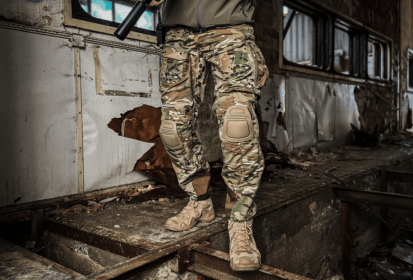
Lower muzzle flash, reduced recoil, and improved weapon control in CQB and night-time operations.
Suppressors have thus moved out of the “covert equipment” category and into the role of a common accessory that enhances both safety and comfort.
More than a century of development has proved that suppressors are not a movie myth but a practical engineering solution with clear benefits. From the earliest patents and experimental prototypes to today’s robust, reliable designs, their role has changed fundamentally.
Suppressors are no longer the exclusive domain of special units — hunters, sport shooters, and professionals increasingly use them. They have become a common accessory that protects hearing, enhances safety, and improves shooting comfort.
👉 In the next article we’ll explore why every shooter should consider a suppressor and the practical advantages they bring in the field.