

- Outdoor Clothing and Footwear

- All in the category Outdoor Clothing and Footwear
- Footwear

- Jackets

- Military Blouses

- Pants

- Functional clothing

- Sweatshirts

- Shirts

- Hawaiian & Lifestyle Shirts

- T-Shirts

- Shorts and Bermuda

- Overalls

- Caps and head coverings

- Gloves

- Socks

- Belts

- Suspenders

- Scarves, shawls, neckwear

- Raincoats, ponchos

- Women's clothing

- Children's clothing

- Clothing Care and Maintenance

- Patches & Insignia

- Vests

- Kemping a turistika

- All in the category Kemping a turistika
- Backpacks

- Bags, satchels, suitcases, waist bags

- Sleeping in nature

- Cookers, grills

- Lighting a fire

- Outdoor Dishes and Tableware

- Dining in nature (Food for the journey)

- Survival kit

- Compasses

- Climbing equipment

- Flashlights

- Camping furniture

- Eye-glasses

- Telescopes

- Hydration

- Water purification

- Small Equipment and Essentials for Survival

- Electronics and accessories for mobile phones

- Watches

- Cases

- Paracords

- Wallets

- Towels

- Solar showers

- Waterproof notebooks

- Mosquito and Insect Protection

- Foot, hand, and body warmers

- Repair Kits and Adhesive Tapes

- Boating equipment

- Health, protection

- Tactical Gear

- All in the category Tactical Gear
- Plate Carriers and Tactical Accessories

- Load-bearing harnesses

- Tactical vests

- Tactical cases and pockets

- Ballistic protection

- Hearing protection

- Protection

- Tactical and military backpacks

- Tactical and combat belts

- Tactical Eyewear

- Flashlights for soldiers and police

- Helmets, coverage

- Camouflage

- Gas masks and protective equipment

- Medical equipment

- Boxes, cases

- Battering rams, crowbars

- Gear for dogs

- Shooting Supplies

- All in the category Shooting Supplies
- Shooting Glasses

- Weapon bags

- Shooting gloves

- Gun Cases

- Weapon Slings

- Optical sights

- Rangefinders

- Gun flashlights and lasers

- Cleaning, maintenance

- Gun waist bags

- Shooting bags

- Shooting mats

- Boxes and cases for ammunition

- Training equipment for shooting

- Bullet traps

- Speed loaders

- Knives and Tools

- Self-defence

- Firearms and Ammunition

- Other

- By interest


How to Choose a Water-Resistant Backpack and Keep Your Gear Dry
A backpack may be built from rugged Cordura, fitted with water-resistant zippers, and backed by a list of impressive-sounding technologies. That still does not mean you can carry electronics through hours of heavy rain without concern—or submerge the pack while fording a stream. Real-world protection depends not only on the fabric, but also on its treatment, seam construction, zipper design, and the way the entire pack closes. We will examine how to assess these features, what you can realistically expect from a water-resistant backpack, and how to improve protection with a rain cover, pack liner, or individual dry bags.
The key is understanding exactly what the manufacturer means by “water-resistant” and what conditions the pack will actually face. A trip to the range calls for a different solution than a multi-day movement through the field. A paddling trip where complete immersion is possible raises the requirements again.

Durable fabric alone does not guarantee that the contents will remain dry. The coating, seams, zippers, and overall construction are equally important.
Water-Repellent, Water-Resistant, or Waterproof?
Manufacturers do not always use these terms consistently, but there are important differences between the various levels of protection.
- Water-repellent material: Reduces surface wetting. Water beads up and runs off instead of soaking in immediately. This is generally sufficient for light or brief rain, but prolonged exposure may eventually saturate the fabric.
- Water-resistant backpack: Designed to withstand rain, splashing water, or contact with wet vegetation for a limited period. The term alone does not tell you whether the pack can handle a ten-minute shower, several hours of heavy rain, or a brief fall into the water.
- Waterproof or watertight construction: Must address not only the fabric, but also the seams, zippers, closures, and every other potential point of entry. Unless the manufacturer specifies a test standard, protection rating, or defined conditions of use, resistance to immersion should never be assumed.
The basic rule is simple: waterproof fabric does not automatically make a waterproof backpack.
The Fjällräven High Coast Foldsack 24 provides a good example. The manufacturer describes the main fabric as waterproof but also notes that the seams are not taped and the zipper is not water-resistant. The pack therefore offers good protection from rain, but it should not be considered fully sealed.

The Fjällräven High Coast Foldsack 24 uses waterproof fabric, but its seams are not taped. It is therefore not designed for immersion or as the sole protection for moisture-sensitive equipment.
Fabric and Denier: Durability Is Not Waterproofing
Tactical and outdoor backpacks are commonly made from nylon, polyester, or fabrics from the Cordura family. These materials differ in weight, strength, and abrasion resistance, but the name alone tells you little about the water resistance of the finished pack. Cordura, for example, is valued primarily for its mechanical durability. Its ability to resist water depends on the specific water-repellent treatment or coating applied to it.
A rating such as 500D or 1000D does not indicate water resistance. Denier refers to the linear density of the yarn: a higher number generally means a heavier, more robust fabric. How well that fabric resists water depends on its subsequent treatment, coating, and construction.
If the manufacturer specifies a hydrostatic-head rating, it usually applies to the fabric itself. Seams, zippers, pockets, and other construction details may reduce the protection offered by the completed backpack.
DWR, PU, and TPU: What the Abbreviations Mean
Water resistance can be improved through various surface treatments, coatings, and laminates.
- DWR, or Durable Water Repellent, is a water-repellent treatment applied to the outside of the fabric. It encourages water to bead and run off while slowing saturation, but it does not create a dependable barrier against water penetration on its own. Its effectiveness also decreases over time through wear, abrasion, and contamination.
- PU, or polyurethane coating, is usually applied to the back of the fabric to reduce water penetration through the material. The Maxpedition Falcon III and Gyrfalcon are examples. Their manufacturer specifies nylon fabric with a triple PU coating and a water-repellent surface treatment, yet still describes the packs as water-resistant rather than suitable for immersion.
- TPU, or thermoplastic polyurethane, may be used as either a coating or laminated layer. It is flexible and allows materials to be joined by welding, which is why it commonly appears in dry bags, waterproof cases, and technical luggage. The letters TPU alone, however, are no guarantee of watertight construction.
Seams Are Often the Weakest Point
Conventional stitching drives a needle through the material and leaves a small hole with every pass. Each puncture may seem insignificant, but a backpack can contain thousands of them. During prolonged rain, water often begins to enter around the seams.
Taped or welded seams provide better protection. With seam tape, however, it is important to determine whether it actually seals the joint or merely protects the edge from fraying. You should also check whether every seam has been treated or only the areas most exposed to rain.
Welded seams do not perforate the material with a needle and can provide a higher level of protection. The Klymit Splash 25 uses this approach, combining PU-coated nylon, welded seams, and a roll-top closure similar to those found on dry bags. Its construction is therefore better suited to wet conditions than that of a conventional sewn backpack. Without a clearly stated immersion rating, however, it still should not be treated as submersible.

The Klymit Splash 25 combines PU-coated fabric, welded seams, and a roll-top closure, providing better water protection than a conventional sewn backpack.
A Water-Resistant Zipper Is Not a Waterproof Zipper
Zippers are among the most common weak points in backpack construction. Standard coil zippers leave small gaps between their elements, allowing water to work through during prolonged rain. Protection can be improved with an overlapping storm flap or a laminated layer over the zipper tape.
YKK AquaGuard is a typical example. The name may suggest a fully sealed closure, but YKK itself describes AquaGuard as water-repellent rather than waterproof. When evaluating a zipper, also examine how closely the sliders meet, whether their end positions are covered, and where the zipper is located on the pack.
The more zippers, pockets, and separate access points a backpack has, the more potential routes water can exploit. Fully sealing a heavily compartmentalized tactical pack is therefore far more difficult than sealing a simple roll-top bag.
How the Main Compartment Closes
A conventional zipper provides fast access and supports a well-organized layout, while a drawstring collar or roll-top reduces the length of the exposed opening.
A drawstring collar covered by a top lid directs most water away from the main opening. In wind-driven rain or when the pack is placed in wet grass, however, water may still enter through other parts of the construction.
A roll-top closure reduces the number of potential entry points. The upper edge is folded or rolled several times and secured with a buckle. A roll-top alone, however, cannot compensate for unprotected seams, cable ports, or additional pockets.
Also inspect the hydration-tube port, sewn-on MOLLE panels, lower access zippers, and especially the base. When the backpack rests on wet ground, its bottom is exposed not only to water but also to pressure from the full load.
How Much Protection Do You Actually Need?
The highest possible level of water protection is not automatically the best solution for every user. A welded roll-top pack may protect its contents extremely well, but it may not provide as many pockets, the same speed of access, or equivalent attachment options as a conventional tactical backpack.
For a trip to the range or a short transfer, water-repellent fabric and separate protection for electronics may be enough. For a full day in the field, water-resistant materials, protected openings, and a rain cover kept close at hand make more sense.
On a multi-day operation, it is prudent to assume that the backpack alone may not be sufficient. A wet sleeping bag, insulation layer, or spare socks are more than a comfort issue. If the route involves fording, the risk of falling from a watercraft, or possible full immersion, the internal protection must be selected accordingly.
How to Improve the Water Resistance of a Standard Backpack
In practice, layered protection is usually the most reliable approach. If one layer fails, the entire load does not immediately become saturated.
A Rain Cover Protects the Pack from Above
A rain cover is lightweight, compact, and quick to deploy. It protects the front and sides of the backpack, external pockets, and some equipment attached to the outside. Certain packs store the cover in a dedicated lower pocket or double-layer base.
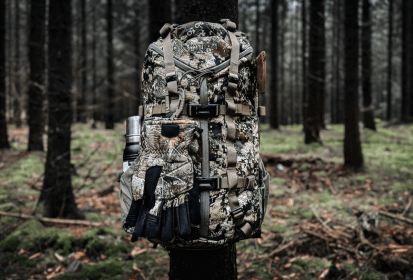
TheWisport SilverFox 2 is one example. Its manufacturer specifies a Cordura construction and a rain cover stored in the double bottom rather than claiming that the backpack itself is waterproof. It is therefore a durable tactical pack whose resistance to prolonged rain is improved by a separate cover.
A rain cover does not protect the back panel, and water can run between the pack and the wearer. It may shift or snag in wind and dense vegetation, restrict access to pockets, and provides no protection during immersion. In tactical use, you must also consider whether it covers equipment that needs to remain immediately accessible.

The Wisport SilverFox 2 is made from mechanically durable Cordura and stores a rain cover in its double-layer base for additional protection during prolonged rain.

A Pack Liner Protects the Main Compartment
A waterproof pack liner is a large bag placed inside the main compartment. Equipment is packed into the liner, which has its own closure—usually a roll-top. The outer backpack may become saturated, but water cannot reach the protected contents.
The advantage is that the backpack retains its original harness, mechanical durability, and external attachment system. The trade-off is reduced organization and slower access to equipment stored at the bottom. Products such as the Tasmanian Tiger WB Liner 40L fall into this category.
Dry Bags Protect the Most Sensitive Equipment
Instead of using a single large liner, the load can be divided among several smaller dry bags. A sleeping bag, spare clothing, electronics, batteries, medical supplies, and fire-starting equipment can all be packed separately.
This improves organization and provides redundancy. If one bag is damaged, the entire load does not necessarily become exposed. Different colors or sizes also make equipment easier to identify in darkness or under stress.
One example is the Snugpak Dri-Sak, a roll-top bag available in several capacities.
Although its fabric is waterproof, the complete bag is not designed for prolonged immersion. Lightweight dry bags should also not be used to carry unprotected sharp or abrasive objects that could damage the material from the inside.
Phones, power banks, documents, and moisture-sensitive medical supplies should receive an additional layer of protection in separate sealed pouches. Here again, it is important to distinguish between protection from rain and equipment specifically rated for immersion.
READ NEXT: Water-Resistant Gear: How to Keep Yourself and Your Equipment Dry

The Klymit Splash 25 combines PU-coated fabric, welded seams, and a roll-top closure, providing better water protection than a conventional sewn backpack.
Ask Five Questions Before You Buy
- How long will the backpack be exposed to rain?
- Is rain the only concern, or could the pack also fall into the water?
- Which items must remain dry under all circumstances?
- How quickly do you need access to the contents?
- Does the manufacturer’s rating apply to the fabric or to the complete backpack?
The Best Protection Uses Several Layers
No single technology can guarantee that the contents will remain dry. Protection depends on both the backpack’s construction and the way the equipment is packed. A well-made water-resistant pack may be sufficient for ordinary rain. In more demanding conditions, add a rain cover, pack liner, or individual dry bags. A properly layered system can keep critical gear protected even inside a backpack that was never designed to impersonate a submarine.


Readers are further interested